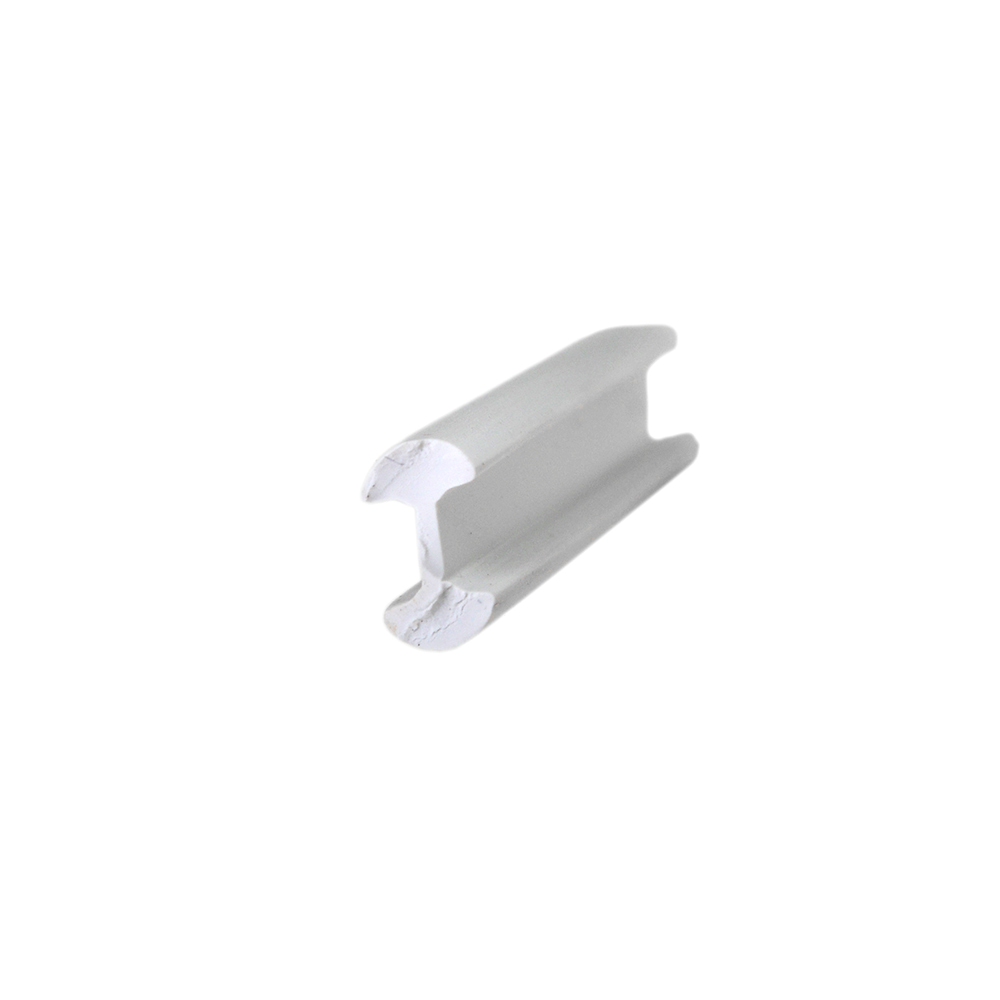
 Actual product photo
Original photos
Use the original photos and specifications to choose your product.
Ref SF-3717
View the full rangePlastic double piping cord / Blind Seam Profile 5mm 300 mtr
£378.00 per metre
No VAT added. Free standard delivery for this item. Postcode surcharges may apply. Delivery and returns
1. Choose your options
2. Choose quantity in metres
Listed as in stock on 13 November 2026. Availability reflects this catalogue update.
Product details
Quantity: 300 mtr.5mm plastic double piping cord, also known as blind seam profile, for creating a neat decorative double-piped finish while concealing the staple fixing beneath the profile. Cover the profile with your chosen upholstery fabric, position it along the finished furniture edge and staple through the central fixing channel. Once fitted, the profile closes over the staple line to produce a clean professional finish. A Long-Nose Upholstery Staple Gun is particularly useful for this product, helping reach accurately into the narrow central fixing channel. Use it for chair backs, headboards, furniture facings, decorative panels and other suitable fixed upholstery. Available per metre or in a 300 metre quantity.
Full description and care
5mm Plastic Double Piping Cord / Blind Seam Profile
5mm Plastic Double Piping Cord is a specialist upholstery finishing profile designed to create a neat double-piping effect while concealing the fixing staples beneath the finished trim.
Also known as a blind seam profile, it is used differently from conventional piping cord.
The profile is covered with upholstery fabric, positioned along the required furniture edge and stapled through its central fixing channel. Once secured, the profile closes over the fixing line, helping conceal the staples and leaving two neat parallel piping rolls visible.
Available:
- Per metre
- 300 metre quantity
Typical applications include:
- Upholstered chair backs
- Sofa backs
- Headboards
- Furniture facings
- Decorative upholstered panels
- Outside furniture sections
- Fixed decorative seams
- Feature borders
- Areas where a concealed staple line is required
see the Piping Cords range for specialist double piping together with cotton, paper, washable and plastic piping cords.
How Blind Seam Double Piping Works
Unlike ordinary piping cord that is sewn into a cushion or upholstery seam, blind seam profile is fitted directly to the finished furniture.
The plastic construction forms two parallel rounded piping sections separated by a central fixing channel.
A typical fitting process is:
- Cut a suitable strip of upholstery fabric.
- Cover the double-piping profile evenly with the fabric.
- Position the covered profile along the required finished line.
- Staple through the central fixing channel into suitable supporting timber.
- Work progressively along the profile, keeping the trim straight.
- Close the piping sections over the fixing channel.
- Check that the staples are concealed and both piping rolls sit evenly.
The result is a decorative double-piping border with the mechanical fixing hidden beneath the finished trim.
Why a Long-Nose Staple Gun Is Particularly Useful
A long-nose upholstery staple gun is strongly associated with fitting blind seam and double-piping profiles because of the restricted central fixing channel.
The extended nose allows the tool to reach further between the two raised piping sections, helping place the staple accurately without the main body of the staple gun interfering with the profile.
The BEA 71/16-436 Long-Nose Pneumatic Staple Gun has a 50mm extended nose specifically made for accessing restricted upholstery fixing areas.
also supplies the Senco Xtreme 71/16 Long-Nose Pneumatic Staple Gun for professional 71-series fine-wire fastening where extended access is required.
A long-nose tool is particularly useful for:
- Blind seam double piping
- Narrow fixing channels
- Decorative upholstery trims
- Tight furniture corners
- Recessed frame sections
- Areas close to adjoining padding
- Detailed furniture finishing
- Other restricted upholstery fixing positions
The advantage of the long nose is access and accurate staple placement. It does not alter the staple specification or increase fastening power.
Choosing the Correct Upholstery Staples
Double piping must be secured using staples compatible with both the staple gun and the furniture construction.
Browse 71-Series Upholstery Staples for fine-wire upholstery staples in a choice of leg lengths.
71-series staples are widely used throughout professional furniture upholstery and have a narrow 10mm crown.
When selecting the staple, consider:
- Staple-gun model
- Required staple series
- Material thickness
- Fabric layers
- Profile construction
- Timber depth
- Frame hardness
- Required penetration
Do not simply select the longest staple available.
The staple needs sufficient penetration to secure the profile without risking excessive penetration through shallow furniture timber or nearby components.
Keep the Staple in the Central Fixing Channel
Accurate staple positioning is important.
The staple should be driven through the intended central fixing area rather than through either of the visible rounded piping sections.
Keeping the fixing centred helps:
- Prevent distortion of the profile
- Keep the two piping rolls even
- Allow the profile to close correctly
- Conceal the fixing line
- Produce a straighter finished border
This is another reason a Long-Nose Staple Gun can be especially useful with this product.
Work gradually along the furniture rather than placing widely spaced staples and trying to pull the profile into line afterwards.
Cover with Matching or Contrasting Fabric
The 5mm double-piping profile is designed to be covered with upholstery material before installation.
Browse Upholstery Vinyl & Fabric for furniture coverings suitable for the wider upholstery project.
Using the same fabric as the furniture creates a subtle, tailored border.
A contrasting fabric can turn the double piping into a stronger decorative feature around:
- Chair backs
- Headboards
- Sofa panels
- Furniture facings
- Feature inserts
- Decorative borders
Make a short covered sample first where the fabric is especially thick, heavily textured, patterned or difficult to manipulate.
Cutting Fabric for Double Piping
Accurate fabric strips make the profile easier to cover consistently.
Use professional Upholstery Shears & Snips to prepare clean, even strips of upholstery material.
When cutting, consider:
- Strip width
- Fabric thickness
- Grain direction
- Pattern direction
- Stretch
- Position of joins
- Furniture shape
- Required finished appearance
Professional side-bent shears such as the Wilkinson 3119CP Side-Bent Scissors are particularly useful for long controlled cuts through upholstery fabric laid flat on the workbench.
Patterned & Striped Upholstery Fabric
Because double piping creates a strong visual line around the furniture, pattern direction deserves particular attention.
With striped or patterned fabric:
- Establish the finished direction before cutting
- Cut strips consistently
- Consider the pattern repeat
- Plan joins before fitting
- Avoid obvious pattern changes in prominent areas
A slightly uneven strip may be much more noticeable when wrapped around two parallel piping rolls than when the same fabric is used on a larger flat upholstery panel.
Fitting Double Piping Around Chair Backs
Blind seam profile is particularly useful for finishing upholstered chair backs.
After the main covering has been fitted, the double piping can be positioned around the perimeter to conceal an underlying fixing edge and create a defined decorative border.
Suitable applications can include:
- Dining chair backs
- Occasional chairs
- Armchairs
- Feature back panels
- Traditional upholstered chairs
- Decorative furniture inserts
The profile should follow the intended furniture line without twisting or creating uneven spacing between the two visible piping rolls.
Double Piping for Headboards
The profile is also well suited to suitable upholstered headboards.
It can be used to define:
- Outer headboard edges
- Decorative borders
- Internal panels
- Contrasting fabric sections
- Shaped headboard outlines
Where a headboard is being made or rebuilt, browse Foam Sheets for suitable padding and Polyester Wadding for creating a softer outer finish beneath the fabric.
Where polyester wadding is bonded to foam, use Status Fabrics Heavy Duty Spray Adhesive to keep the wrap positioned, prevent shifting or bunching during cover fitting and help create a smooth, consistent finished surface.
Decorative Furniture Panels & Facings
Double-piping profile can provide a clean finishing border around many suitable fixed upholstered panels.
Examples include:
- Sofa side panels
- Chair facings
- Decorative back panels
- Upholstered wall panels
- Furniture inserts
- Feature panels
The profile provides the visible finishing detail while concealing the staple fixing underneath.
This makes it particularly useful where a conventional exposed fixing would detract from the appearance of the finished furniture.
Measuring the Required Length
When ordering double piping by the metre, measure the complete furniture perimeter or finishing line rather than estimating from the overall furniture width and height.
Allow additional material for:
- Corners
- Curves
- Joins
- Test pieces
- Cutting waste
- Pattern alignment
- Production variations
Browse Measuring & Marking Tools and Rulers & Tape Measures for professional workroom measuring equipment.
For repeat furniture production, record the actual quantity used on the first successful unit to make future material calculations easier.
Planning Joins
Where more than one length
Additional product information
5mm plastic double piping cord, also known as blind seam profile, for creating a neat decorative double-piped finish while concealing the staple fixing beneath the profile.
Cover the profile with your chosen upholstery fabric, position it along the finished furniture edge and staple through the central fixing channel. Once fitted, the profile closes over the staple line to produce a clean professional finish.
A Long-Nose Upholstery Staple Gun is particularly useful for this product, helping reach accurately into the narrow central fixing channel.
Use it for chair backs, headboards, furniture facings, decorative panels and other suitable fixed upholstery.
Available per metre or in a 300 metre quantity.
see the Piping Cords range.
Range options and attributes
- Quantity
- 300 mtr, Per Meter
Specifications are reproduced from supplied product data and have not been checked against a physical sample. Colours vary between screens and devices, so on-screen images may not exactly match the physical material.