
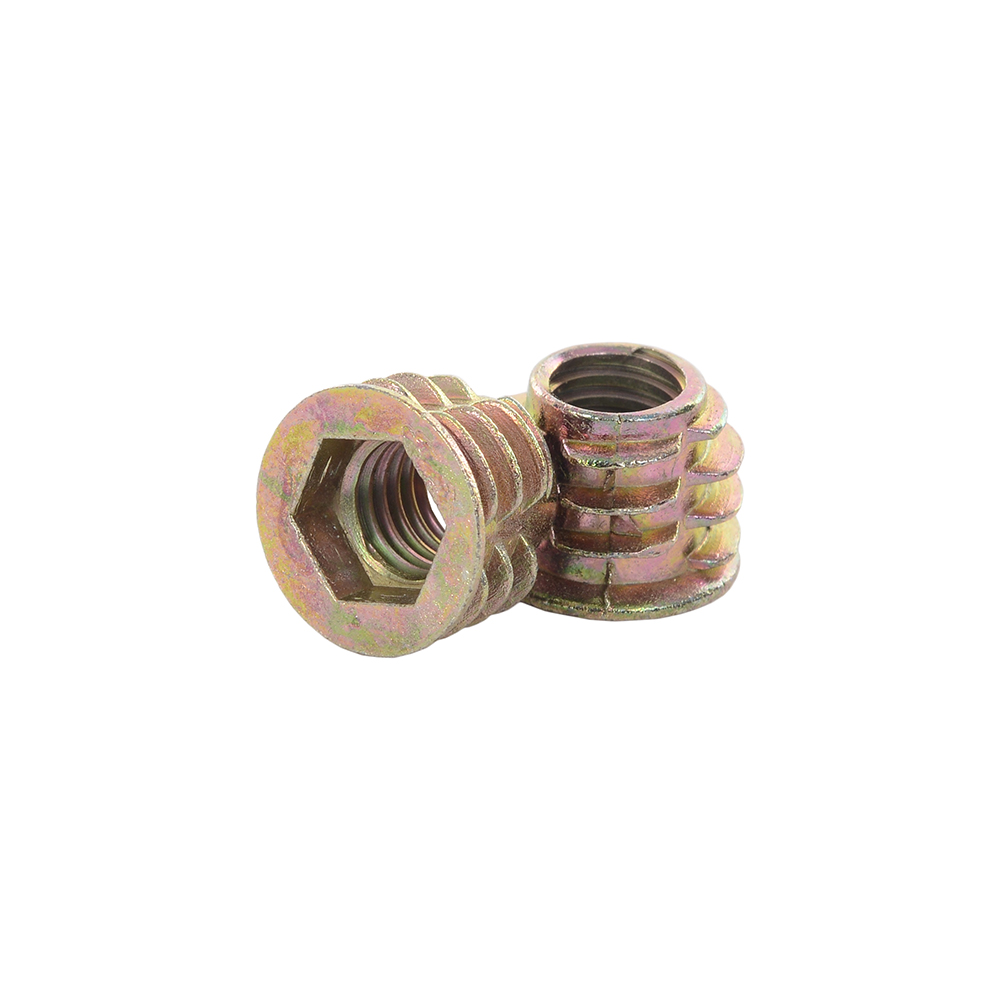
 Actual product photo
Original photos
The AI setting is for illustration. Use the original photos and specifications to choose your product.
Ref SF-2883
M10 D Nuts
£32.64
No VAT added. Delivery for this item: £15.54. Standard delivery is free on orders of £240 or more. Delivery and returns
1. Choose your options
View this option on its own2. Choose quantity
Listed as in stock on 13 November 2026. Availability confirmed before payment.
Product details
M10 x 13mm D nuts for creating a strong, reusable threaded fixing point in suitable timber furniture frames. Use it for attaching compatible M10 threaded furniture legs, sofa feet, chair feet, glides and other removable furniture components. Unlike a four-prong T nut, the D nut has a coarse external thread that screws directly into a correctly prepared pilot hole. It is installed using a suitable hex key, while the internal M10 thread accepts the matching furniture leg, threaded stud or fitting. The external thread provides a positive grip in the timber and helps resist the insert working loose during normal use. An integral flange controls the fitting depth and helps protect the surrounding surface from being damaged as the insert is installed. This makes M10 D nuts particularly useful for furniture manufacture, upholstery, repair and refurbishment where a strong threaded fixing is required and access to the reverse of the furniture frame may be limited. Available in: packs of 100 and 1000
Full description and care
M10 D Nuts for Furniture Legs, Feet and Threaded Fixings
M10 x 13mm D nuts provide a strong threaded anchor point within suitable timber furniture frames, allowing compatible furniture legs, sofa feet, glides and other M10 threaded components to be fitted securely while remaining removable when required.
Also known as furniture D nuts, screw-in insert nuts, threaded furniture inserts or furniture leg fixing nuts, they are widely used in upholstery, furniture manufacture, repair and refurbishment where a strong metal thread needs to be created directly within the timber.
Unlike a T nut, which relies on a flange and gripping prongs, a D nut has a coarse external screw thread. This allows the fitting to be installed directly into a correctly prepared pilot hole using a suitable hex key.
M10 x 13mm Screw-In Furniture Insert
The D nut has a M10 internal thread for accepting a compatible furniture leg, threaded stud, glide or other suitable furniture fitting.
Its approximately 13mm insert length sits within the timber frame, while the coarse external thread grips the surrounding material.
This external thread helps provide:
- Positive engagement with the timber
- Resistance to rotation
- Resistance to the insert working loose
- A strong reusable furniture fixing
- A secure anchor for removable legs and feet
An integral flange at the top of the fitting also limits how far the D nut can be driven into the frame.
The flange helps spread the load around the fixing and reduces the risk of the insert being screwed too deeply into the timber or damaging a covered surface.
Use it for Furniture Legs and Sofa Feet
M10 D nuts are particularly useful where furniture is designed to accept removable threaded legs or feet.
Typical applications include:
- Sofas and settees
- Armchairs
- Upholstered chairs
- Footstools
- Ottomans
- Upholstered benches
- Bed and divan frames
- Cabinets
- Contract furniture
- Replacement furniture feet
- Furniture manufacturing
- Furniture restoration
- Upholstery repairs
Browse Status Fabrics' Wooden Furniture Feet for traditional and wooden furniture feet, or Metal Furniture Feet & Legs for modern metal furniture leg options.
Always check that the selected furniture leg or fitting has a compatible M10 thread before ordering.
Why Use a D Nut in a Furniture Frame?
One of the main advantages of a D nut is that it can create a threaded fixing from one accessible side of the timber.
This can be particularly useful in upholstered furniture where access behind the frame rail is restricted by upholstery, padding, springs, webbing or other components.
Once installed, the D nut remains within the timber while the furniture leg itself can be screwed in or removed as required.
This is useful where furniture legs need to be removed for:
- Delivery
- Moving through narrow doorways
- Transport
- Storage
- Repair work
- Replacement of damaged feet
- Furniture refurbishment
- Changing the style or height of compatible legs
A removable threaded furniture leg is generally much easier to service than a permanently fixed component.
How M10 D Nuts Are Installed
The D nut is fitted into a correctly prepared pilot hole in the timber furniture frame.
A suitable pilot hole is drilled square to the required direction of the furniture leg.
The D nut is then started carefully into the hole and screwed into the timber using a suitable hex key.
As the insert is driven in, the coarse external thread cuts and grips into the surrounding timber.
Continue until the flange is correctly seated against the surface.
Avoid excessive tightening once the flange has seated. Forcing the insert further can damage the surrounding timber or weaken the fixing.
Once installed, the internal M10 thread should remain clean and correctly aligned so the furniture leg or other threaded fitting can be started easily by hand.
Why the Pilot Hole Matters
The pilot hole plays an important part in the strength of the finished fixing.
If the hole is too large, the coarse external thread may not grip the timber securely enough.
If the hole is too small, excessive force may be required to install the D nut, potentially damaging or splitting the furniture frame.
The correct pilot hole will depend on the construction and condition of the timber as well as the external dimensions of the insert.
Always test the fitting carefully when working with unfamiliar timber or repairing older furniture.
M10 D Nuts or M10 T Nuts?
Both D nuts and T nuts can create a M10 threaded anchor in a furniture frame, but they use very different fixing methods.
a M10 D nut uses a coarse external screw thread and is screwed directly into a prepared hole.
a M10 T Nut uses a barrel, flange and four gripping prongs.
Choose a M10 D Nut Where:
- Installation is required from one side of the frame
- Access behind the timber is restricted
- A screw-in furniture insert is preferred
- A recessed threaded fixing is required
- The timber has sufficient depth for the insert
- A four-prong fixing would be difficult to install
Choose a M10 T Nut Where:
- Access to the rear of the frame is available
- A flange can sit against the back of the timber
- The four prongs can grip securely into sound timber
- The furniture was originally made for a T nut
- A traditional through-hole furniture fixing is required
Neither fixing is universally better.
The correct option depends on the design of the furniture, available access, timber thickness and the type of threaded component being fitted.
Check the Furniture Frame Before Installation
A D nut relies on its external thread gripping sound material.
Before installation, inspect the proposed fixing position and avoid timber that is:
- Split
- Cracked
- Rotten
- Water damaged
- Excessively thin
- Badly enlarged around a previous fixing
- Too close to the edge of the frame rail
Also check for existing screws, staples, frame joints, webbing or other fittings that could interfere with the pilot hole.
When replacing an old D nut, do not assume the original hole is still suitable.
If the timber around the fixing has become enlarged or damaged, a replacement insert may not grip securely without first repairing the frame.
Check the M10 Thread Before Ordering
M10 refers to the nominal diameter of the metric internal thread.
a M10 D nut must therefore be paired with a compatible M10 threaded furniture component.
It is not interchangeable with the smaller M8 D Nut.
Before ordering, check:
- Thread diameter
- Thread pitch where applicable
- Length of the threaded stud
- Furniture frame thickness
- Available timber depth
- Existing hole size
- Condition of the frame
- Required direction of the furniture leg
Do not force an apparently similar threaded fitting into the D nut.
An incorrect thread may begin to engage before tightening suddenly and damaging both components.
Furniture Glides and Floor Protection
D nuts can also be used where a compatible threaded glide is required.
Status Fabrics' Furniture Glides range includes felt, nail, plastic, knock-in and screw-in glide options for furniture repair and floor protection.
The fixing method varies between products, so always check whether the selected glide actually uses a M10 threaded stem before attempting to fit it to a M10 D nut.
Glides are commonly used to:
- Protect hard flooring
- Reduce scratching and scuffing
- Improve furniture stability
- Reduce friction
- Allow easier furniture movement
M10 Threaded Castor Applications
Certain furniture castors also use a M10 threaded fitting.
For example, the Kenrick 60mm Shepherd Castors M10 Fitting use a M10 threaded stem.
Where the furniture construction is suitable and the fixing arrangement is compatible, a M10 threaded insert may therefore form part of a castor installation.
However, many castors use completely different fixing systems, including sockets, grip-neck stems and mounting plates, so always check the castor fixing method carefully rather than assuming a M10 connection is required.
Use with Furniture Leg Serrated Washers
When installing compatible wooden furniture legs, a Plastic 50mm Serrated Washer can provide a useful additional fitting between the furniture leg and the underside of the furniture.
The serrated washer helps resist the leg working loose and also helps prevent the top of the leg damaging the fabric or covering on the underside of the furniture.
This makes it a useful complementary component for furniture production and repair work using removable threaded wooden legs.
Furniture Feet, Castors and Glides
For the finished furniture assembly, browse the full Feet, Castors & Glides range.
The section includes:
- Wooden Furniture Feet
- Metal Furniture Feet & Legs
- Furniture Castors
- Furniture Glides
Always match the furniture component to the correct thread and fixing system before ordering.
M10 D Nuts for Upholstery and Furniture Manufacture
M10 D nuts provide a compact, strong and reusable method of installing a threaded anchor within suitable timber furniture frames.
They are well suited to professional upholsterers, furniture manufacturers, repair workshops, restorers and experienced DIY customers working with removable furniture legs and compatible threaded fittings.
Available in packs of 100 and 1000.
For alternative thread sizes and furniture fixing methods, see the T Nuts, D Nuts & Fixings range.
Additional product information
M10 x 13mm D nuts for creating a strong, reusable threaded fixing point in suitable timber furniture frames. Use it for attaching compatible M10 threaded furniture legs, sofa feet, chair feet, glides and other removable furniture components.
Unlike a four-prong T nut, the D nut has a coarse external thread that screws directly into a correctly prepared pilot hole. It is installed using a suitable hex key, while the internal M10 thread accepts the matching furniture leg, threaded stud or fitting.
The external thread provides a positive grip in the timber and helps resist the insert working loose during normal use. An integral flange controls the fitting depth and helps protect the surrounding surface from being damaged as the insert is installed.
This makes M10 D nuts particularly useful for furniture manufacture, upholstery, repair and refurbishment where a strong threaded fixing is required and access to the reverse of the furniture frame may be limited.
Use with suitable products from the Wooden Furniture Feet and Metal Furniture Feet & Legs ranges, or browse Furniture Glides and the wider Feet, Castors & Glides collection.
Where a four-prong fixing is more suitable for the furniture construction, see the M10 T Nuts. For alternative thread sizes and furniture fixing methods, see the T Nuts, D Nuts & Fixings range.
Available in packs of 100 and 1000.
Range options and attributes
- Quantity
- Pack of 100, Pack of 1000
Specifications are reproduced from supplied product data and have not been checked against a physical sample. Colours vary between screens and devices, so on-screen images may not exactly match the physical material.