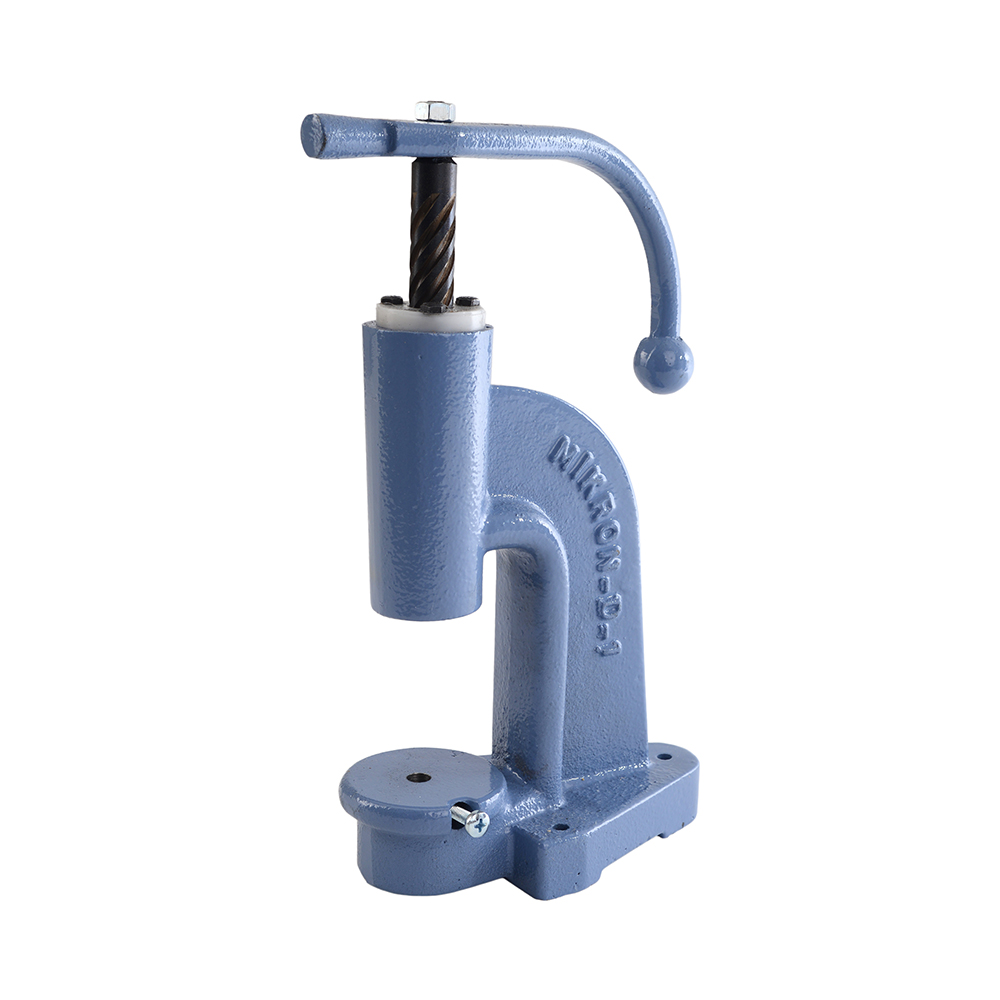
 Actual product photo
Original photos
The AI setting is for illustration. Use the original photos and specifications to choose your product.
Ref SF-2356
D-1 Button Press
£115.20
No VAT added. UK delivery £15.54, free on orders of £180 or more. Delivery and returns
Choose quantity
Listed as in stock on 13 November 2026. Availability confirmed before payment.
Product details
Practical hand-operated D-1 upholstery button press for producing professional fabric-covered furniture buttons using compatible button dies. Suitable for button die sizes #20 to #60. Made for making fabric-covered upholstery buttons. Simple hand-operated workshop press. Suitable for standard and thicker-material button dies. Use it for headboards, sofas, chairs, footstools and deep-buttoned upholstery. Suitable for professional upholsterers, furniture manufacturers and restoration workshops. Supplied as the press only. Button dies and accessories sold separately. For standard upholstery fabric, pair with a compatible Button Die. For leather, vinyl and heavier upholstery materials, use the specialist Button Die for Leather, Vinyl & Thick Fabric. Prepare covering material accurately using a suitable Fabric Cutter and combine with matching Aluminium Button Shells and the appropriate button back.
Full description and care
D-1 Upholstery Button Press for Covered Button Making
The D-1 Button Press is a practical hand-operated upholstery press made for producing professional fabric-covered furniture buttons.
Compatible with button die sizes from #20 to #60, it provides a straightforward workshop solution for upholsterers, furniture manufacturers, headboard makers, restorers and soft furnishing businesses making covered buttons on a regular basis.
The D-1 is supplied as the press only, allowing you to select the button dies, cutters, shells and backs required for the particular sizes and materials you work with.
Product Specification
- Product type: Upholstery button press
- Model: D-1
- Operation: Hand operated
- Compatible button die sizes: #20 to #60
- Application: Fabric-covered upholstery button making
- Suitable materials: Dependent on the selected button die
- Supplied as: Press only
- Button dies: Sold separately
- Suitable for: Upholstery workshops, furniture manufacture, restoration and button production
What Is the D-1 Button Press Used For?
The D-1 upholstery button press provides the controlled pressure needed to form covering material around an upholstery button shell and secure the selected button back.
When fitted with the correct die, the press can be used to produce covered buttons for:
- Headboards
- Sofa backs
- Chairs
- Footstools
- Ottomans
- Cushions
- Upholstered bed panels
- Decorative furniture panels
- Furniture restoration
- Replacement upholstery buttons
- Deep-buttoned furniture
Using a proper button press helps produce a more consistent finished button than attempting to assemble covered buttons manually.
Button Press for Professional Upholstery Work
Covered buttons are used across traditional and modern upholstery, but consistency becomes particularly important when a project requires several matching buttons.
The D-1 press helps provide:
- Consistent button formation
- Repeatable pressure
- Better alignment of shell and back
- Cleaner fabric wrapping
- Reduced variation between buttons
- Faster production than manual assembly
- A professional workshop method for covered-button making
This makes it suitable for both individual restoration jobs and repeated button production.
Works with Button Dies from #20 to #60
The D-1 press is designed to accept compatible button dies covering sizes from #20 through to #60.
The actual button sizes available will depend on the die and button components selected.
Status Fabrics' standard Button Die range currently includes:
- Size 24
- Size 30
- Size 36
- Size 44
These sizes correspond with commonly used upholstery button shells and backs.
Always make sure the die, button shell and button back are the same nominal size.
Standard Button Dies for Upholstery Fabric
For conventional upholstery fabrics, use the standard Button Die.
A standard covered-button setup normally consists of:
D-1 Button Press Button Die Aluminium Button Shell Upholstery Fabric Compatible Button Back
The die forms the material around the shell and joins the shell to the selected backing component when pressure is applied through the press.
This combination is suitable for many furniture and general upholstery fabrics.
Button Dies for Leather, Vinyl & Thick Fabric
Leather, vinyl and heavier upholstery fabrics create more bulk around the button shell than standard woven fabric.
For these materials, use the specialist Button Die for Leather, Vinyl & Thick Fabric.
The specialist die is made for use with thicker covering materials including:
- Leather
- Faux leather
- Upholstery vinyl
- Heavy woven fabric
- Thick decorative upholstery fabrics
Selecting the correct die for the material helps produce a cleaner covered button and reduces the risk of poorly formed buttons or wasted components.
Making Fabric-Covered Buttons with the D-1 Press
Producing a covered button requires several correctly matched components.
A typical setup includes:
- D-1 Button Press
- Correct-size button die
- Aluminium button shell
- Upholstery fabric
- Compatible button back
- Fabric cutter
Cut the Covering Material
Use a suitable Fabric Cutter to produce accurately sized fabric circles.
Consistent cutting helps provide enough material to wrap around the shell without creating unnecessary bulk inside the finished button.
Position the Fabric and Button Shell
Place the fabric and compatible Aluminium Button Shell into the correct section of the die.
Keep the covering material centred so it forms evenly around the shell.
Add the Button Back
Position the selected button back in the matching section of the die.
The type of back will depend on how the finished button needs to be fixed to the furniture.
Operate the D-1 Button Press
Use the press to bring the die components together and form the covered button.
After pressing, check that:
- The fabric is centred
- The material is securely retained
- The button back is correctly attached
- The shell has formed evenly
- There are no loose folds around the button edge
Testing one complete button before beginning a larger production run is recommended.
Choosing the Correct Button Back
Button Wire Backs
Button Wire Backs provide a wire loop at the rear of the covered button.
They are commonly used for traditional and deep-buttoned upholstery where strong upholstery twine is used to pull the button through the furniture.
Button Prong Backs
Button Prong Backs use long prongs that pass through suitable upholstery layers.
They can be retained from the reverse with compatible prong washers.
Hook Backs
Hook Backs produce covered buttons designed to attach to a prepared upholstery twine loop.
Tape Backs
Tape Backs accept long and short button tapes for through-buttoning applications such as caravan cushions and bedding.
Choose the button back according to the furniture construction and fixing method rather than the appearance of the button alone.
D-1 Button Press for Headboard Buttons
Headboards are one of the most common applications for fabric-covered upholstery buttons.
The D-1 can be used to produce consistent covered buttons for:
- Deep-buttoned headboards
- Diamond buttoning
- Square button layouts
- Upholstered bedheads
- Decorative bed panels
- Feature wall panels
Using the same shell, die, cutter and fabric preparation method throughout the project helps keep every button consistent.
D-1 Button Press for Deep Buttoning
Deep-buttoned upholstery may require dozens of matching buttons.
The D-1 press is useful for producing covered buttons for:
- Sofa backs
- Armchairs
- Chesterfield-style furniture
- Footstools
- Ottomans
- Headboards
- Upholstered wall panels
- Decorative furniture
Once made, the buttons can be fitted using the appropriate wire, prong, hook, tape or nail-back fixing system.
D-1 Button Press for Furniture Restoration
The press is also useful when reproducing missing or damaged buttons on existing furniture.
Before making a replacement button, check:
- Existing button size
- Shell diameter
- Button-back type
- Covering material
- Fabric thickness
- Original fixing method
- Button depth
Matching the original construction helps replacement buttons blend more naturally with the existing upholstery.
D-1 Button Press for Regular Workshop Production
A button press becomes particularly useful when a workshop regularly produces batches of covered buttons.
Typical users include:
- Professional upholsterers
- Furniture manufacturers
- Headboard manufacturers
- Furniture restorers
- Soft furnishing workshops
- Contract furniture manufacturers
- Bespoke furniture makers
- Automotive and trimming workshops
The D-1 allows the press itself to remain part of the workshop setup while different button dies are fitted according to the current job.
D-1 Button Press or TEP-2 Press?
The D-1 Button Press is primarily focused on covered-button production.
The TEP-2 Press provides a broader fastening setup because compatible dies can also be fitted for press studs and rivets.
Choose the D-1 when the main requirement is producing fabric-covered upholstery buttons.
Consider the TEP-2 where the workshop also needs one press system for compatible:
- Upholstery buttons
- Press studs
- Rivets
Both presses require the appropriate dies or attachments, which are sold separately.
D-1 Button Press or D-3 Fabric & Button Press?
The D-1 provides a straightforward solution for covered-button manufacture.
For workshops requiring a broader fabric-and-button production system, browse the Buttoning Tools range, which also includes the D-3 Fabric & Button Press and specialist die sets.
The most suitable press depends on the type and volume of work being carried out.
Press Only, Dies Sold Separately
The D-1 is supplied as the press only.
This allows you to build the button-making setup around the sizes and materials required for your own work.
Depending on the application, you may also need:
- Button Die
- Button Die for Leather, Vinyl & Thick Fabric
- Fabric Cutter
- Aluminium Button Shells
- Compatible button backs
Check the required sizes before ordering so all components work together.
Complete Your Upholstery Button-Making Setup
For standard fabric-covered buttons, combine the D-1 press with the correct Button Die, Fabric Cutter and matching Aluminium Button Shells.
For leather, vinyl and heavier covering materials, choose the specialist Button Die for Leather, Vinyl & Thick Fabric.
Browse Button Parts for wire backs, prong backs, hook backs, tape backs, washers and other button components.
Browse Buttoning Tools for presses, dies, fabric cutters, leather cutters and specialist button-fitting tools.
For help selecting the correct press, die, cutter or button components, contact us.
Additional product information
Practical hand-operated D-1 upholstery button press for producing professional fabric-covered furniture buttons using compatible button dies.
- Suitable for button die sizes #20 to #60
- made for making fabric-covered upholstery buttons
- Simple hand-operated workshop press
- Suitable for standard and thicker-material button dies
- Use it for headboards, sofas, chairs, footstools and deep-buttoned upholstery
- Suitable for professional upholsterers, furniture manufacturers and restoration workshops
- Supplied as the press only
- Button dies and accessories sold separately
For standard upholstery fabric, pair with a compatible Button Die.
For leather, vinyl and heavier upholstery materials, use the specialist Button Die for Leather, Vinyl & Thick Fabric.
Prepare covering material accurately using a suitable Fabric Cutter and combine with matching Aluminium Button Shells and the appropriate button back.
Specifications
- Product type
- Upholstery button press
- Model
- D-1
- Operation
- Hand operated
- Compatible button die sizes
- #20 to #60
- Application
- Fabric-covered upholstery button making
- Suitable materials
- Dependent on the selected button die
- Supplied as
- Press only
- Button dies
- Sold separately
- Suitable for
- Upholstery workshops, furniture manufacture, restoration and button production
Specifications are reproduced from supplied product data and have not been checked against a physical sample. Colours vary between screens and devices, so on-screen images may not exactly match the physical material.