
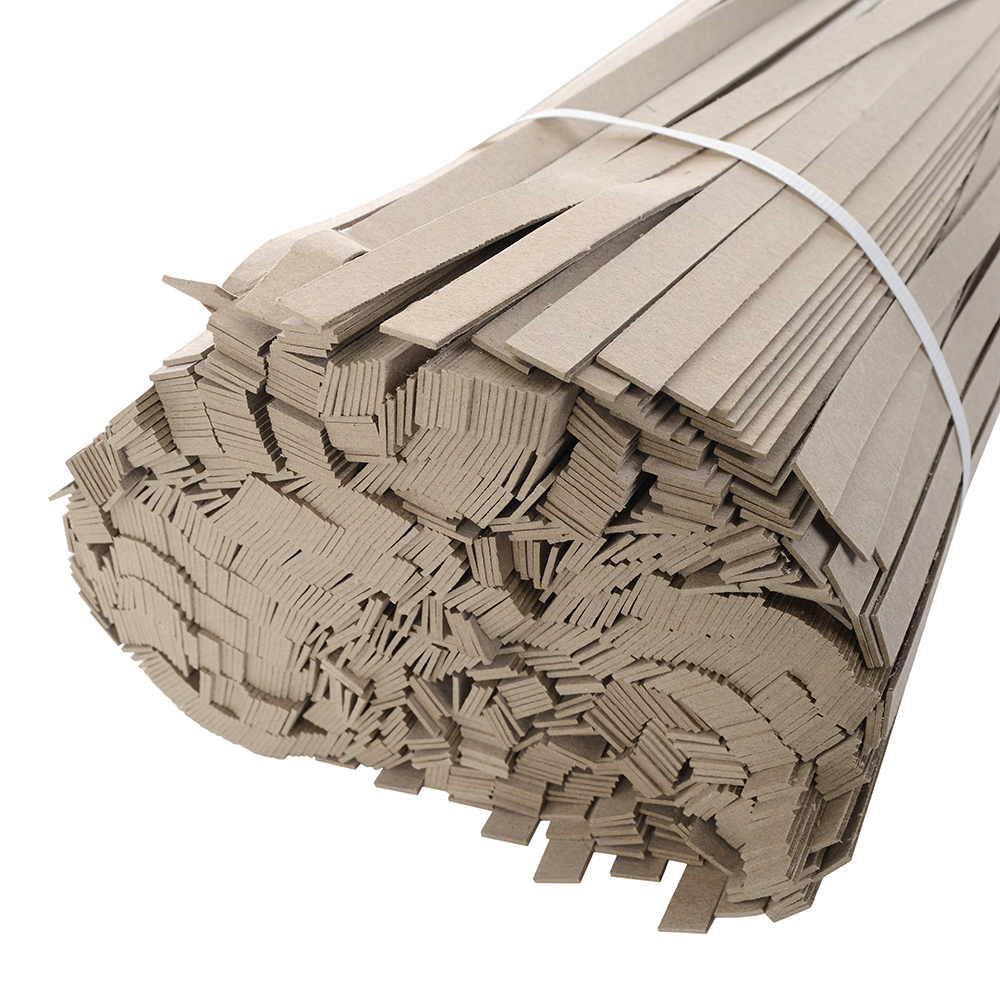
 Actual product photo
Original photos
The AI setting is for illustration. Use the original photos and specifications to choose your product.
Ref SF-2838
Cardboard back tack strips ½” x 40″ (box of 1000)
£76.80
No VAT added. Delivery for this item: £15.54, plus a £4.20 large item charge once per order. The £15.54 is free on orders of £240 or more. The extra charge still applies. Delivery and returns
Choose quantity
Listed as in stock on 13 November 2026. Availability confirmed before payment.
Product details
Pre-cut 1/2" x 40" upholstery cardboard tack strips for creating clean, straight concealed fabric edges on outside backs, arms, panels and other suitable furniture sections. The strip is stapled through the upholstery fabric and into the furniture frame before the fabric is folded back, concealing the fixings and helping produce a neat professional edge. Supplied pre-cut to approximately 1/2" wide x 40" long in a box of 1,000 strips, making them particularly convenient for busy upholstery workshops and repeat furniture production. Use with suitable Upholstery Staple Guns & Tackers and correctly matched Upholstery Staples.
Full description and care
Upholstery Cardboard Tack Strips for Clean Finished Edges
Upholstery Cardboard Tack Strips are pre-cut strips made for back-tacking upholstery fabric and producing a clean, straight concealed edge on suitable furniture.
Each strip measures approximately 1/2" wide x 40" long and is supplied in a box of 1,000 strips.
They are particularly useful for professional upholsterers, furniture manufacturers, repair workshops and repeat production where a consistent supply of ready-cut cardboard strips saves having to cut individual strips from sheet material.
Typical applications include:
- Outside sofa and chair backs
- Outside arms
- Upholstered furniture panels
- Headboard edges
- Straight fabric returns
- Concealed upholstery seams
- Furniture facings
- Repeat production upholstery
see the Tacking Strips range for cardboard, metal and flexible upholstery edge-fixing systems.
How Cardboard Tack Strip Works
Cardboard tack strip provides a straight reference edge around which upholstery fabric can be turned.
The strip is positioned along the required finished line with the covering fabric and secured to the timber furniture frame using suitable upholstery staples.
The fabric is then folded back over the strip, concealing both the cardboard and the staple line.
When positioned accurately, this method creates a clean finished fabric edge without leaving an exposed row of staples.
A typical process is:
- Position and tension the upholstery fabric correctly.
- Establish the required finished edge.
- Position the cardboard strip along that line.
- Staple through the strip and fabric into suitable frame timber.
- Keep the strip straight while progressing along the edge.
- Fold the fabric back over the strip.
- Check that the finished line is straight, smooth and consistent.
The quality of the final edge depends heavily on the accuracy of the strip underneath it. Any dip, twist or misalignment in the cardboard can show through once the fabric is folded into position.
Use it for Outside Backs & Arms
Cardboard back-tacking strip is particularly useful when finishing the outside backs and arms of upholstered furniture.
These areas often need a neat concealed transition between the visible covering and the furniture frame without an exposed fixing line.
It can be used on suitable:
- Sofa backs
- Chair backs
- Outside arms
- Headboards
- Upholstered side panels
- Furniture borders
- Straight facings
Before fitting the strip, make sure the underlying furniture build-up is complete and the intended finished edge has been established.
Where the furniture also requires new padding, browse Foam Sheets for upholstery foam suitable for backs, arms, padding and furniture repair.
Use with Upholstery Staple Guns
Cardboard tack strip is normally fixed using a suitable upholstery stapler or tacker.
Professional upholstery workshops commonly use fine-wire pneumatic staple guns because they provide fast, repeatable fixing when working on furniture production and reupholstery.
The Status Fabrics range includes standard-nose and long-nose upholstery staple guns, as well as electric and hand-operated alternatives.
The correct tool depends on:
- Frequency of use
- Access to the fixing area
- Staple series required
- Furniture-frame construction
- Available compressor or electrical supply
- Whether a standard or extended nose is required
Always match the staple gun to the correct staple series rather than selecting staples simply because they appear to fit the magazine.
Choosing the Correct Upholstery Staples
The strip, fabric and furniture frame are secured together using suitable Upholstery Staples.
For example, 71/10 Staples are part of the professional 71 Series system used throughout the upholstery trade.
The correct staple should be chosen according to:
- Staple gun specification
- Staple series
- Material thickness
- Number of material layers
- Timber depth
- Frame hardness
- Required leg length
A longer staple is not automatically better.
Using an unnecessarily long staple can result in poor driving, bent staples or excessive penetration, while a staple that is too short may not provide sufficient holding power.
Always check the stapler manufacturer's permitted staple range before ordering.
Standard-Nose or Long-Nose Staple Gun?
For open, easily accessible furniture sections, a standard-nose upholstery staple gun is generally suitable.
A long-nose stapler can be useful where the fixing line sits within a deeper or more restricted furniture section.
This may include:
- Narrow frame channels
- Internal corners
- Deep furniture rebates
- Areas close to padding
- Restricted sections around furniture rails
see the Pneumatic Guns & Tackers range to compare professional staple guns, electric staplers and hand tackers.
Pre-Cut 40" Strips for Production Upholstery
The pre-cut 40-inch length makes these strips particularly convenient for repeat upholstery production.
Rather than repeatedly cutting lengths from a roll, workshop staff can take a ready-cut strip, trim it to the exact furniture section if required and continue with the job.
This can be particularly useful for:
- Sofa and chair manufacturers
- Repeat furniture ranges
- Headboard production
- Contract upholstery
- Reupholstery workshops
- Training workshops
- High-volume furniture repair
The box of 1,000 provides a practical quantity for regular professional use.
For workshops that prefer to cut every strip to its own required length, There is also the 137m Roll 1/2" Cardboard Tack Strip.
The roll format may be more convenient for furniture with widely varying dimensions or particularly long uninterrupted edges, while the pre-cut 40" strips are well suited to repeat production and general workshop use.
Cutting & Trimming Cardboard Tack Strips
Although supplied in ready-cut 40" lengths, individual strips
Additional product information
Pre-cut 1/2" x 40" upholstery cardboard tack strips for creating clean, straight concealed fabric edges on outside backs, arms, panels and other suitable furniture sections.
The strip is stapled through the upholstery fabric and into the furniture frame before the fabric is folded back, concealing the fixings and helping produce a neat professional edge.
Supplied pre-cut to approximately 1/2" wide x 40" long in a box of 1,000 strips, making them particularly convenient for busy upholstery workshops and repeat furniture production.
Use with suitable Upholstery Staple Guns & Tackers and correctly matched Upholstery Staples.
see the Tacking Strips and Cardboard & Fibreboard ranges.
Specifications are reproduced from supplied product data and have not been checked against a physical sample. Colours vary between screens and devices, so on-screen images may not exactly match the physical material.